Friday, July 31, 2009

Berry Picking Bucket

Berry picking time! A beautiful blogger friend, Jumbleberry Jam, made the cutest berry picking buckets out of felt, ribbon and yogurt cups. She inspired me to make some berry picking buckets too, but we needed them to be a little bit bigger because we have a lot of berries to pick.


I have A LOT of containers that I have been saving (just can't throw them out) for just the right activity and this is it! These containers (from Trader Joe's) are great because you can easily peel off the labels and there is a blank cardboard canvas to work with. I poked holes in the sides, ripped the cloth straps from one of Araina's old dresses and knotted them on. I then let the girls decorate the buckets however they pleased.


Now for the berry picking! We have a ton of berries to pick; it's just hard to get to a lot of them because they are surrounded by poison ivy. Good thing we have a lot of jewelweed around to make the "rashy plant" home remedy.


Visit Jumbleberry Jam to see how she made her berry buckets for her little guy. Visit this post at 5 Orange Potatoes at Wordpress. I will be making the final move this weekend. I will be using my own domain and found a way to upload the Friend Connect. ;)

Thursday, July 30, 2009

Jewelweed Poison Ivy Remedy

It’s that time of year for picking wild blackberries and elderberries. And wherever the berries grow, the poison ivy grows. Here is the remedy I use to prevent or treat that horrible itch (and other plant related rashes)!

You need: jewelweed, calendula blossoms (optional), apple cider vinegar, glass jar


This is poison ivy, avoid it at all costs. I find the new growth just darling and beautiful but don’t let that tempt you to touch it! Remember the rule “Leaves of three, let it be!”


This is jewelweed (Impatiens capensis). It likes the same habitat as poison ivy and stinging nettle; so if you see those, do a little hunt for jewelweed. Harvest 1 part jewelweed to 2 parts apple cider vinegar; please only harvest what you will use. Bruise the jewelweed up a bit, place it in a clean jar and cover with apple cider vinegar. Let it steep for a week or two, strain out the plant material and there you have the “magic elixir.” You can place the liquid in an ice cube tray and freeze for up to a year. When needed take the cube and rub onto the infected area. My sister Katrina keeps the plant and all in the vinegar and uses a cotton ball to apply; she keeps this on her bathroom counter, this is good too, but it won’t keep as long. Should you be out in the field and be exposed to poison ivy, split open the stem of the jewelweed and apply directly to infected area.


I like to add a couple of calendula blossoms to help heal the skin and moisturize. I also use this remedy for other plant related rashes and allergies. Like whenever the Little Ladies convince me to go into our field without long pants on, I always come out in pain with a grass rash!
Visit 5 Orange Potatoes at Wordpress for better quality photos!

Wednesday, July 29, 2009

How to Raise Eastern Black Swallowtail Caterpillars

Every spring we plant a lot of parsley, dill and fennel in hopes of luring the Eastern Black Swallowtail (Papilio polyxenes) to lay her eggs in our garden. Last year we released over 25 EBS butterflies, which we raised from larva to adult. This year we haven’t found nearly as many, but we do have some. Just today I found this beauty on a a Queen Anne’s Lace (another host plant of the EBS and another reason to let a patch of QAL grow wild in your yard).


Eastern Black Swallowtail caterpillars look different at different stages; those stages are called instars, and the caterpillars shed their skin between each. I was so surprised when I first learned this and then saw it with my own eyes.


We like to give our caterpillars lots of room to move and lots of the fresh food to eat. Our EBS habitat is an aquarium with parsley planted directly in garden soil. Parsley grows really well this way, fennel and dill usually get too big so if an EBS prefers fennel, dill or Queen Anne’s Lace then I have to replace it daily. I just place the fennel and dill in the tank mingled in with the parsley in hopes that the caterpillar will go for the parsley (usually they do if they are young enough when placed in the tank). I am not a fan of the plant in a vase of water method because I have seen caterpillars fall into the water and drown. My sister Katrina (a butterfly expert at a local arboretum), recommends putting the stems of freshly picked larval host plants in green oasis that has been soaked with water, this keeps the plants fresh longer and doesn’t endanger the caterpillars. We put sticks in the habitat for the caterpillars to form their chrysalises on when they are ready. We have a screen top made to fit on this aquarium to keep the caterpillars in and the predators out. Sometimes the caterpillars like to make their chrysalises on the top, which is fine, but we have to be careful when we move the lid to put fresh food in, water or release butterflies.

The Eastern Black Swallowtail will overwinter in a chrysalis if it hatches from an egg in the fall. If it is kept in a safe place outdoors for the winter, a beautiful welcome of spring is in store come May. With good care and a little patience the beautiful caterpillars will become beautiful butterflies!


*Jump over to 5 Orange Potatoes at Wodpress for a better look of the photos.

Tuesday, July 28, 2009

Lavender Herbal Doll

The lavender has been dried; now it is time to do the tedious job of getting all the dried blooms off the stalk. We have to do this outside because it is so potent; even outdoors it causes a lot of sneezes! The Little Ladies worked hard on this; (sigh) but only for about 30 minutes.


Fauna took the lavender experience to a whole new level and made this lovely lavender doll with peppermint hair. She wanted it to be all natural, but found that rubberbands worked the best to hold the doll together. Needless to say, we still have a lot of lavender blossoms to pull from their stems!


By the way, I'm very busy working on the new, improved and soon to be organized 5 Orange Potatoes at Wordpress. Just remember that it is still under construction. ;) And, following Wordpress sites are easy; just copy the WP address, go to your Blogger dashboard, click "ADD", and paste address into the URL. Don't follow me yet at WP or you will have a FULL dashboard of 5 Orange Potatoes while I transfer the posts. I will continue to post here until the WP site is complete. Thanks again for all the support you have all given me. Even those of you that haven't commented, I can't believe how much traffic has gone to Faunarain. Thank you!
Lisa :)

Monday, July 27, 2009

Make a Pretty Paperweight and How to Press Queen Anne's Lace


For today's post visit 5 Orange Potatoes at Wordpress. I'm anxious to know opinions........

Sunday, July 26, 2009

Being Kissed by a Toad and a Thank You


Now, my toad kiss to you and a Thank You!


Thank you everybody who commented on my "moving" post. I can't tell you how much help you have been. I am still toying with the many options out there; really loving the photo flexibilty on Wordpress. My Blogger site might be different in the next week, just toying with it to see what can be done on Blogger before actually making a move.

Sunflowers A Bloomin'!


Happy Sunday!

Saturday, July 25, 2009

Moving 5 Orange Potatoes?

Thinking seriously of moving my blog. I just can't get Blogger to do the organization my blog needs. I want bigger pictures and tabs across the top; those many pictures down the right side of the screen are way too much! My computerman hubby has been toying with Fauna's site for a while now trying to make the template I want, but I'm starting to think it would just be easier to move.
I have been toying with Wordpress today here's the link if you want to see it....Faunarain. Horrible name, just a tester. I will move my entire 5 Orange Potatoes blog if I decide to move.
I would love opinions of Wordpress and Typepad. Also would love advice from those that have moved from Blogger. Thank you in advance!

Lisa :)

Happy Birthday Goose!

Lisa, Fauna, Araina and Harvey the hedgehog wish Goose (Fairy Magic) a Happy 9th Birthday!


Here's a wish for happiness
and many dreams come true!
Not only on your special day,
but always - all life through!

Friday, July 24, 2009

Easy Herbal Syrup (Lavender)

You Need:
1/3 cup dried lavender
1 1/2 cups sugar
2 1/2 cups water


Steps:
1. Combine lavender, sugar, and water in a medium saucepan.
2. Bring to boil, turn down the heat to a simmer.
3. Simmer until syrup thickens and is bubbling in a thick frothy manner (about 45 min.).
4. Cool and strain.
5. Discard lavender.
6. Very good drizzled on soy vanilla ice cream.

*This recipe can be used with any herb of your choice.

Thursday, July 23, 2009

The Milkweed Community

That wonderful intoxicating smell of common milkweed (Asclepias syriaca) blossoms lures all kinds of little critters to it. The majority of insects that feed on a milkweed are in some form of red/orange and black due to a chemical in the sap. Fascinating stuff! Here are some of the critters we found in our backyard milkweed community.


Yellow-Collared Scape Moth (Cisseps fulvicollis) on the left, skipper down below.


Ermine Moth (Atteva punctella)

Milkweed Beetle (Tetraopes tetraophthalmus): I am so in love with this adorable insect. The milkweed beetle has 4 eyes instead of 2, the antennae are between the eyes. These little creatures will fall from the milkweed when threatened as a form of defense. They will play dead for a bit then scurry back up the milkweed when danger has passed. They didn't seem to be too frightened of the camera though, this little fellow came up to the tip of the leaf for a closer look.


Fuzzy spider stalking my little milkweed beetles. Shoo you!


The
Monarch Butterfly (Danaus plexippus) of course. Seeing the monarch butterfly on the milkweed causes Fauna to jump up and down yelling, "Do you see her abdomen touching the leaves??!!" She is determined to see a female laying eggs on the milkweed this year.


The monarch caterpillar resting after a morning of munching leaves. A full grown monarch caterpillar can eat an entire milkweed leaf in 4 minutes. Reminds me of some little growing girls I know!


Some fun milkweed facts from EEK!:

*Its Latin name, Asclepias syriaca, is named in honor of the Greek god of healing Aesculapius.

*Sap from milkweed was used by pioneers as a cure for warts.

*The airborne fluffy parachute of the seed was used by Native Americans to insulate moccasins.

*The dried empty seed pods were used as Christmas tree decorations by early pioneers.

*The boys and girls from Wisconsin schools collected 283,000 bags of milkweed fluff for use in military life jackets during World War II.

*It is used as an indicator of ground-level ozone air pollution.

Wednesday, July 22, 2009

What happens if you give a bobcat catnip?

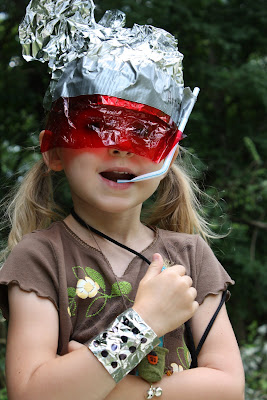
The girls are spending their afternoons this week at the local natural history museum attending camp. They are aliens from the planet Rootbeer, their mission is to explore the life of planet Earth. When I first saw their alien masks I couldn't stop laughing!


This is what I do while they are enjoying camp. Lots of quality and peaceful sewing time!

Madison the Bobcat
I had just been reading about catnip in "stalking the healthful herbs," by Euell Gibbons. This is what Ms. Gibbons had to say in regards to cats and catnip, "The most remarkable thing about catnip is the strange fascination this plant has for members of the cat family, not just the domestic cat, but all felines from great lions and tigers down to tiny civets.....trappers are able to lure the wily lynx just by bating thier traps with a few drops of oil of catnip." Incredible!
I know it sends our house cats into crazyland, but does it really do this to the wild variety of cat? I wondered if the naturals history museum's resident bobcat, Madison, would be put in a tizzy if she had some catnip. My baby sis, Robin, works at the museum, loved the idea, and told us to bring in catnip, lavender and grapefruit mint for Madison to play with. The museum was curious to see which herb she would like the most. She was very intrigued by all the herbs and rubbed her cute little face over all three, but catnip was by far her favorite! The Little Ladies were pleased with their gift to Madison!


Tuesday, July 21, 2009

Solar Eclipse

Our fascination with the moon continues this month with the solar eclipse that takes place tomorrow. I found some great sites to learn about the eclipse and some fascinating legends associated with a solar eclipse.


The Facts!
Solar Eclipses for Beginners- this is a fantastic site, with great illustrations, explaining how a solar eclipse works.


The Legends!
Something Is Eating the Moon and Sun! (From the Old Farmer's Almanac)
Before people understood the science of eclipses, myths and legends were rampant. Here are a few:

• Ancient Egyptians believed that a mythical pig swallowed the Moon.


• According to Mayan folklore, a jaguar swallowed the Moon.
• Today, in the Arctic, Eskimos, Aleuts, and Tlingits believe that an eclipse allows the Moon or Sun to leave the sky to see that things are all right on Earth.

Science-v-Superstition!
The Sun Eating Dragon and Other Ways to Think About an Eclipse-We LOVE this site, great thought provoking stories! The site quotes literature, science and legends of the solar eclipse, then leaves you this question, "What power does knowledge have over terror? Does knowing how something works diminish its beauty and mystery? Or is the beauty of the world deepened by understanding the things we see? As you watch the total solar eclipse along with us and learn more about eclipses, ask yourself how your perception of this unique event is affected by the things you're learning. "


Moon WIP


Enjoy!

Monday, July 20, 2009

sneak peek

Here's a little sneak peek of a tutorial I'm working on while the Little Ladies are at camp this week.

Favorite Educational "Toys"

Birdsong Identiflyer- we have learned a lot of bird calls with this INCREDIBLE gadget. You buy individual cards with many different bird calls on it. Some of the cards are Yard Birds, Field Birds, Forest Edge Birds, Birds of Prey, Frog Chorus, and many other great ones. Araina loves to flirt with the Cardinal and Tufted Titmouse using the Identiflyer. She'll push the bird call and they will sing right back to her. It's a little on the expensive side (each card is $10 and the Identiflyer is around $30), but well worth it!


Heritage Illustrated Playing Cards- we found these in a nature center in West Virginia. The girls just LOVE them! Pictured below are Wild Flowers and Backyard Birds, the Little Ladies play with the bird cards the most and fight over the Tufted Titmouse card. The Heritage company has over 30 illustrated decks, some titles are Ocean life, Shells, Vegetable Garden, Insects, Herbs, Shakespeare's Flowers and Plants of the Bible. I really love that they included the latin names of the plants and animals illustrated on the cards. The decks are reasonably priced at $5.95.


This is our newest gadget, borrowed from my sister Katrina, an environmental meter. We have been very interested in microclimates lately. We are hoping to figure out why our blackberries growing on our little forest edge ripened a whole 2 weeks earlier than our field berries; two completely different microclimates. This meter is an anemometer, thermometer, humidity meter, and light meter. This one in particular is very pricey ($208), so I would buy one used or borrow one.